
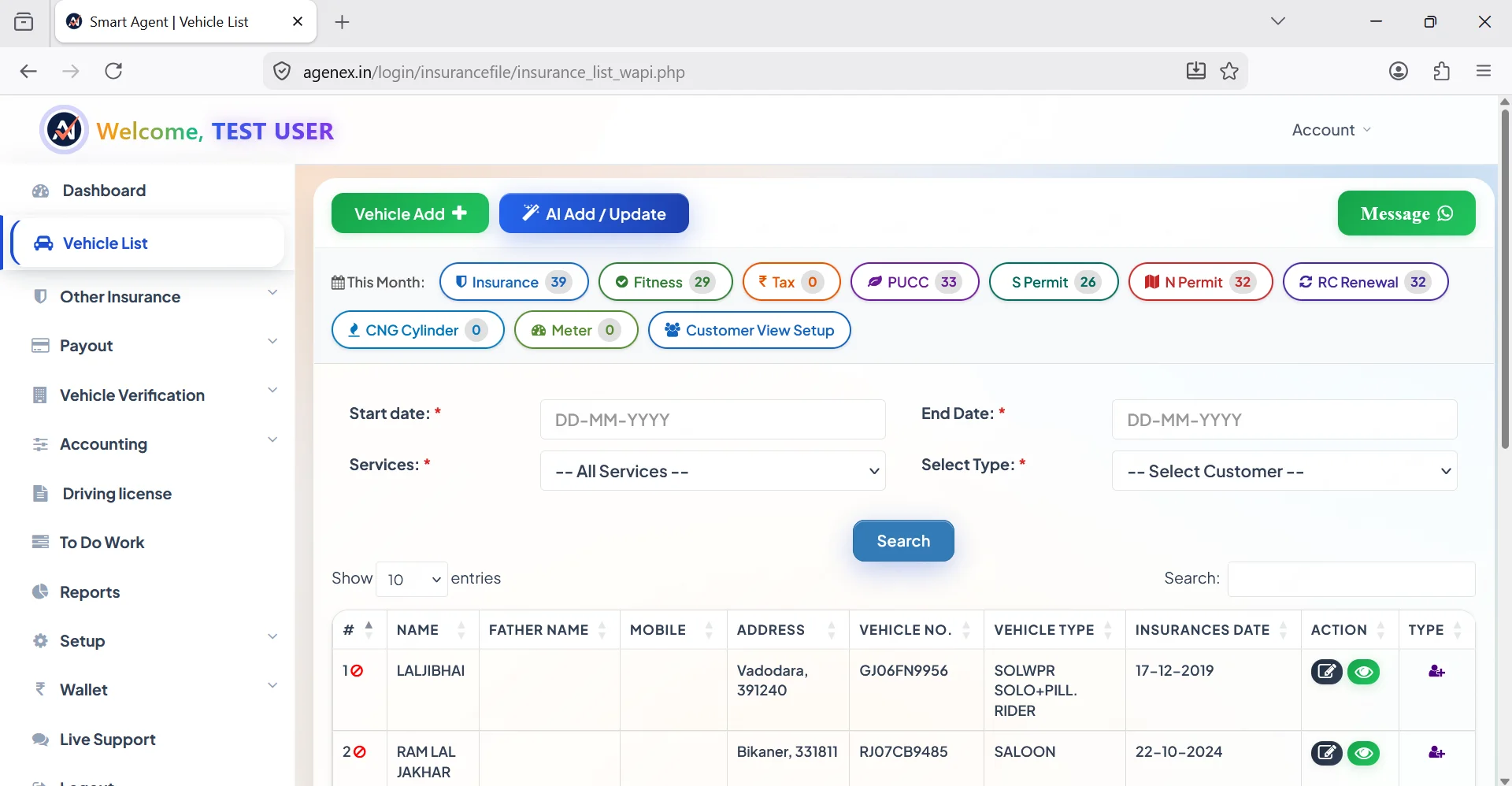
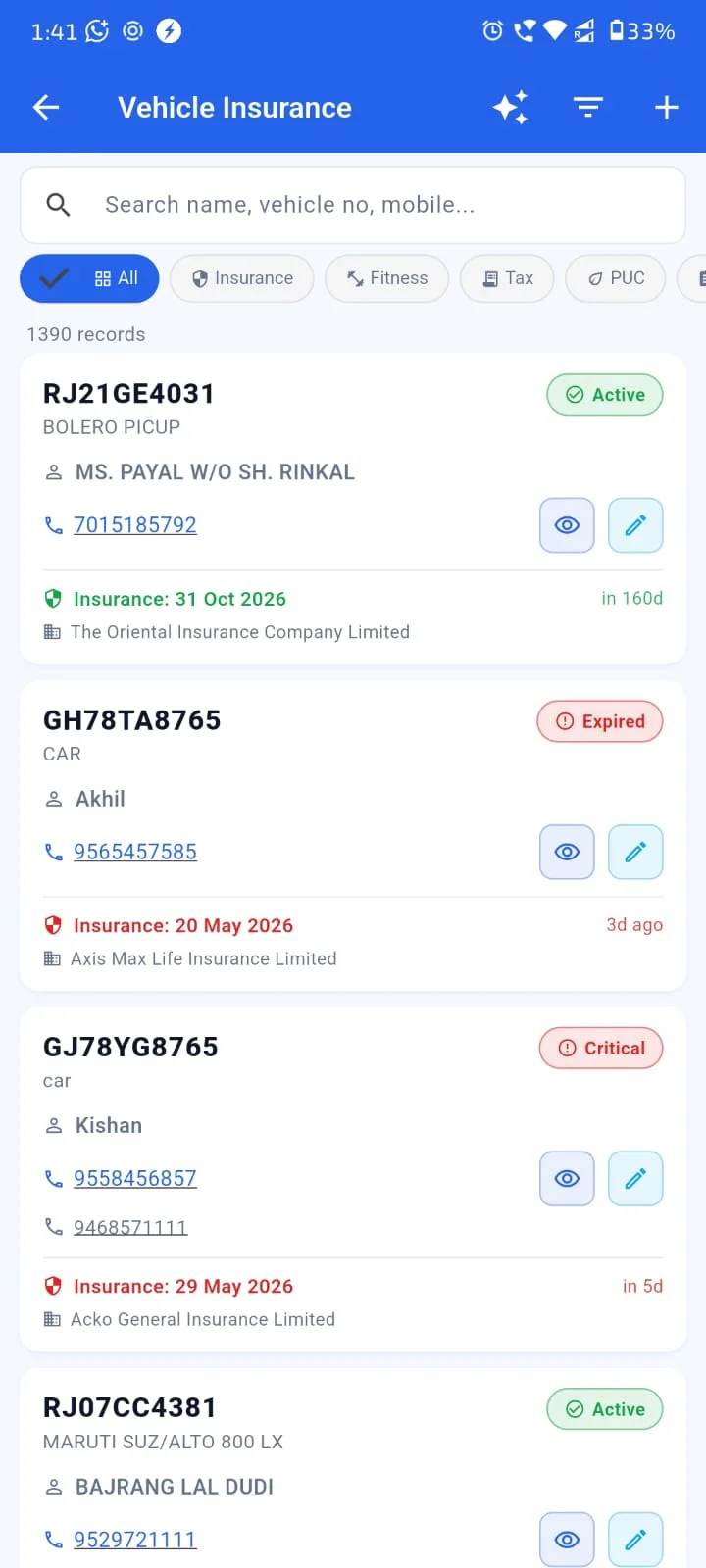
Every motor insurance agent in India is secretly running two tracking systems at the same time — one for insurance policy expiry, and one for RC validity / vehicle fitness. Most agents do this poorly. Diary entries for insurance, mental notes for RC, occasional Vahan portal checks, occasional WhatsApp updates from clients. It works at 50 vehicles. It collapses at 500. A purpose-built insurance policy tracking app for motor agents brings both timelines into a single vehicle record — and that single integration is what makes the difference between a struggling agent and a comfortably profitable one.
This guide explains the dual-timeline reality, why Vahan sync matters for motor agents, how a unified document and renewal view becomes a competitive advantage, and how fleet operators specifically benefit from bulk operations across many vehicles. Whether you're working with 50 personal vehicles or 500 commercial trucks, the underlying principle is the same — vehicles, not policies, are the real organizing unit of a motor insurance business.
Dual-Timeline Tracking — One Vehicle, Two Clocks
The insurance side is straightforward: every vehicle has an annual policy renewal. You know when. Reminders go out at 30/15/7/1 day intervals on WhatsApp via your customer renewal reminder software, and most renewals close cleanly. But the RC side has its own clock — fitness expiry for commercial vehicles, hypothecation status for financed vehicles, registration validity for older vehicles. These don't run on the insurance cycle. They run on their own.
A modern insurance agent app for motor lines shows both timelines on the same vehicle screen. You see insurance expiry, fitness expiry, road tax due, and permit dates all in a single stacked view. When you call a client about insurance renewal, you can also mention "by the way, your fitness is expiring in 45 days" — that one observation often turns a single-renewal client into a two-service client. This kind of relationship-deepening is exactly what the best insurance CRM for agents in India should enable.
Vahan Sync — Keeping RC Records Live
Vehicle ownership in India is fluid. RCs transfer between owners. Cars get hypothecated when financed and de-hypothecated when loans clear. Vehicles get blacklisted after major accidents. A motor agent who relies on the client to tell them about these changes is always 6-12 months behind reality.
An insurance agent app with Vahan / Parivahan integration solves this by allowing on-demand RC checks. You enter the vehicle number, and within seconds you get the current RC status from the official source — current owner, registered address, hypothecation bank (if any), insurance status, fitness validity. If anything has changed since you last interacted with the client, you see it before the next renewal conversation. This is how a motor-focused insurance digital assistant app stops surprises from happening.
Practical example: a customer comes to renew their motor policy. You run a Vahan check. The RC shows the car has been transferred to a new owner six months ago. You discover this before issuing a new policy in the old owner's name. Saved from a future claim repudiation — and from an embarrassing call to the client about premium refund.
Try Agenex Free
Every Agenex feature is included on a free trial — no credit card required. The all in one insurance agent app for motor + RTO + commercial vehicle workflows.
Start Free TrialDriving Licence Manager — Driver-Level Compliance
Personal vehicles have one DL behind them. Commercial vehicles often have multiple drivers — each with their own DL, each with their own validity. School vans, taxis, contract carriages, fleet trucks — all rely on multiple drivers, and the agent who covers these vehicles is implicitly responsible for tracking driver compliance too.
A vehicle-and-driver-aware client portfolio manage karne wala app stores each driver's DL details against the vehicles they drive — DL number, validity, vehicle class endorsements, issuing RTO. When a driver's DL is about to expire, the system alerts both the vehicle owner and the driver. This is the kind of attention to detail that turns a one-time motor renewal customer into a long-term advocate who refers their entire commercial fleet to you.
Bulk Operations — Fleet Agent's Best Friend
If you handle 100+ vehicles for a fleet operator, doing everything one-by-one is impractical. Bulk operations become essential — bulk RC verification at month-start to catch any silent changes, bulk renewal reminders before quarter-end, bulk fitness expiry filtering for the next 90-day window, bulk WhatsApp messages to drivers about an upcoming policy renewal cycle.
Fleet brokers in cities like Pune, Coimbatore, Indore and Lucknow — who often handle 200-1,000 vehicle accounts — find that bulk operations are the single biggest reason they switch from Excel + WhatsApp to a proper insurance agency management software. The math: at scale, the daily time savings from bulk operations alone justify the subscription cost many times over. Commission reconciliation software running alongside this bulk workflow means each renewal also accrues correctly into the commission ledger — no separate manual entry, no end-of-month reconciliation drama.
Who This Workflow Is Built For
This vehicle + RC dual-tracking approach is ideal for: motor insurance agents handling personal vehicles, commercial vehicle insurance brokers handling taxis/trucks/school vans, fleet operators directly managing their own vehicles, RTO consultants whose primary business is documentation but who also sell motor insurance, and POSPs registered through a PoSP agent registration app who specialize in motor lines. Solo agents in their first 1-3 years gain the most relative improvement because the alternative is usually messy diary tracking. Established agencies gain the most absolute time savings because the alternative is paying multiple people to maintain spreadsheets.
Insurance lead manage kaise kare for motor vehicles ka practical answer: build your daily workflow around the vehicle, not the policy. The policy is one transaction. The vehicle is the long-term relationship. An agent who thinks vehicle-first naturally moves toward becoming a multi-service provider for that vehicle owner — insurance, RC services, fitness coordination, permit renewal, eventually even ownership transfer assistance. That's where the lifetime value of each client multiplies.
FAQ
Yes — every vehicle entry shows insurance expiry, fitness validity, road tax due date, permit dates, and PUC expiry in a single stacked view. Reminders for each go out independently in your customer renewal reminder software queue.
Vahan / Parivahan check happens on-demand. You enter the vehicle number, the system fetches current RC status — owner, hypothecation, fitness, insurance status, pending challans. Pay-per-use at Rs.5 per check, pre-paid wallet system.
Yes. Fleet operators can filter vehicles by upcoming renewal date, then send bulk reminders or process renewals as a batch. Useful when handling 50+ commercial vehicles for a single fleet owner.
Yes — each vehicle can have one or more drivers attached, each with their own DL validity. Reminders flow to both vehicle owner and the driver before the DL expiry hits.
Yes — same vehicle entry, same screen. When you handle the insurance, you also see the RC. When you renew the RC paperwork, you see the upcoming insurance. Natural cross-context for cross-sell.
Yes — bikes, scooters and e-bikes all use the same vehicle-centric record. Two-wheeler insurance + RC tracking is one of the most common use cases for solo agents in Tier-2 and Tier-3 cities.
For motor agents, almost always yes. The vehicle is the natural organizing unit. Splitting it across two apps creates synchronization headaches and missed connections between renewal cycles. A unified insurance digital assistant app that handles both removes the friction entirely.