
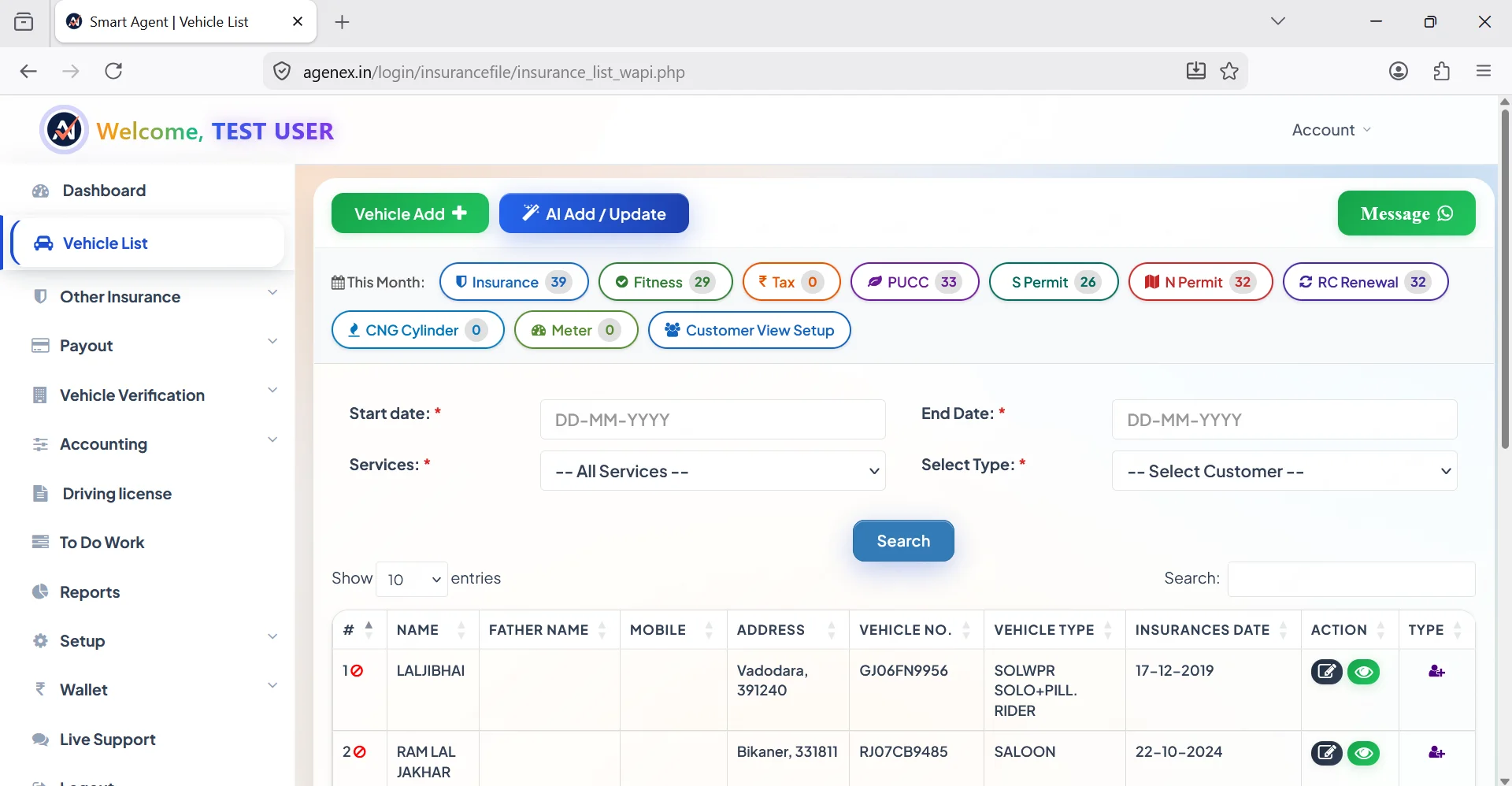
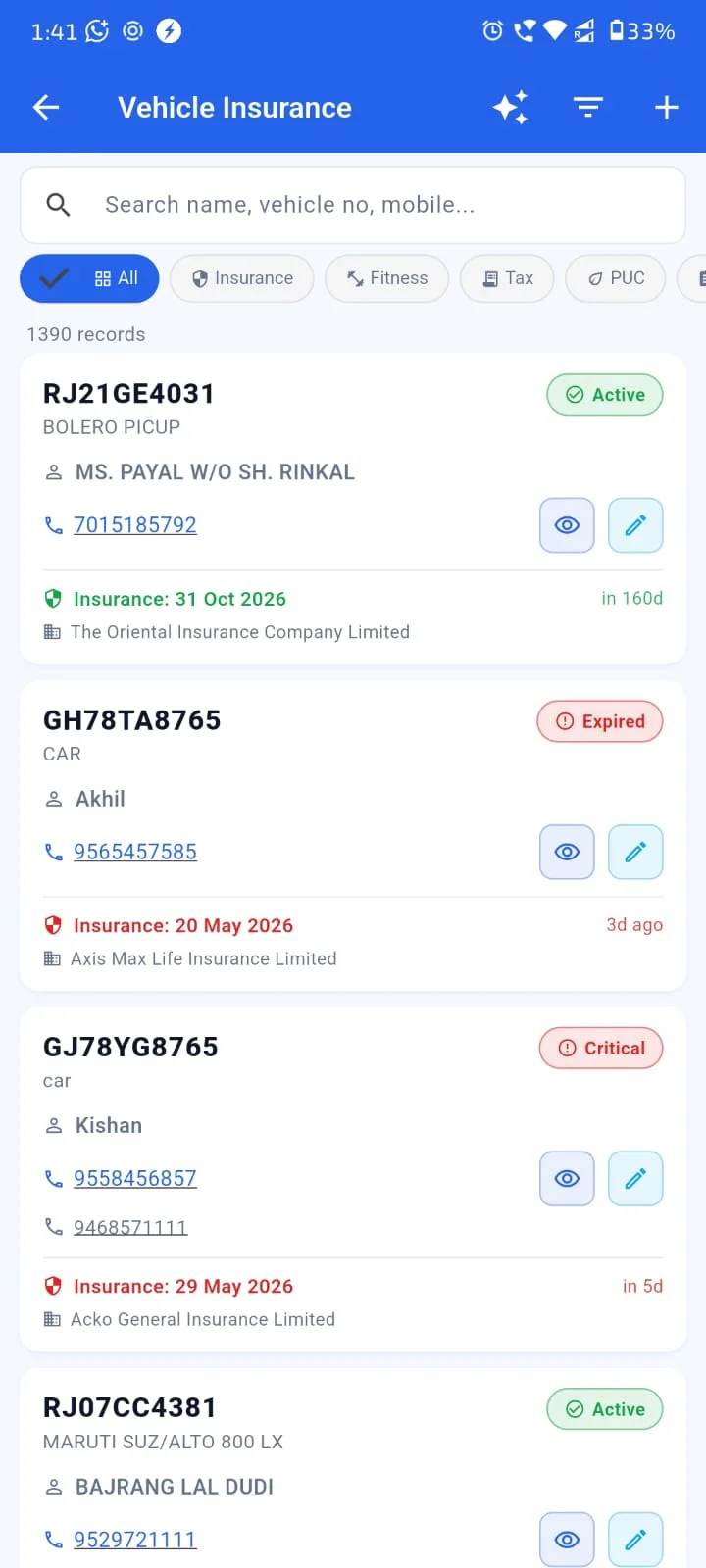
Policy management software is the central hub of an insurance agency. Every other workflow — renewals, WhatsApp reminders, commission tracking, sub-agent splits, accounting, customer portal, agent website — flows from a clean policy record. When the policy record is right, everything else flows. When the policy record is messy (incomplete fields, duplicates, wrong premium, missing nominee), every downstream process inherits that mess. This guide explains what a proper insurance policy tracking app looks like, what fields actually matter, and why search, bulk operations and integration points are non-negotiable for Indian agents handling 200+ active policies.
Most agents underestimate this. They start with a simple Excel sheet. By 100 policies, it's workable. By 300 policies, it's painful. By 600 policies, it's untenable — and that's usually when they finally invest in a real insurance agency management software. The transition is harder than it should be, because you're trying to migrate years of accumulated mess. The lesson: pick the right CRM early, set up policy records correctly from day one, and avoid the painful migration later.
Policy Record Fields — What Actually Matters
A proper policy record holds far more than just policy number and expiry date. Every field has a purpose downstream. Here's what a working best insurance CRM for agents typically captures:
Identity fields: Insurer name (LIC, Bajaj, HDFC ERGO, Star Health, etc.), product / plan name, policy number, period of insurance (start date, end date). These power the renewal cycle.
Financial fields: Sum insured / cover amount, premium amount, premium frequency (yearly, half-yearly, quarterly, monthly), commission percentage, sub-agent split (if applicable). These power commission tracking, payout reports and reconciliation. A good commission reconciliation software reads these fields to auto-calculate per-policy earnings.
Relationship fields: Customer (linked to master customer profile), nominee, family members, family link (joint household). These power cross-sell suggestions and renewal reminders sent to the right person.
Documentation fields: Policy PDF, KYC documents, claim history (if any). These power the customer portal where clients can self-serve their own policy copies — useful as a policy copy download app functionality without you doing manual sharing.
Status fields: Active, lapsed, paid-up, surrendered, claimed. These power business reports and renewal-ratio analytics.
Search and Filters — Speed Matters After 500 Policies
At 100 policies, you can find anything by scrolling. At 500 policies, scrolling becomes painful. At 1,000+ policies, search performance starts mattering more than feature richness. A working client portfolio manage karne wala app needs to find any policy in under 2 seconds by any field — customer name, policy number, RC number, premium range, expiry month, insurer, city, mobile last 4 digits.
Filter combinations are even more important. "Show me all LIC policies expiring in October with premium above ₹25,000 belonging to clients in Mumbai" — that's the kind of query agents need to run during festival campaign planning. A simple grep-style search isn't enough; structured filters with multi-criteria support are what separate a real insurance agent app from a glorified spreadsheet.
Try Agenex Free
Every Agenex feature is included on a free trial — no credit card required. India's all in one insurance agent app for policy management.
Start Free TrialBulk Operations — Essential At Scale
If your book has 500+ active policies, daily operations one-by-one is impractical. Bulk operations become essential.
Bulk import: When you first onboard, you typically have hundreds of records in Excel. A good insurance digital assistant app imports an entire spreadsheet in minutes with a column-mapping wizard. No re-typing. No duplicates.
Bulk export: Month-end reports, tax filing, CA handover, audit preparation — all require pulling data out cleanly. PDF + Excel exports with selected fields and date filters are the minimum standard.
Bulk renewal nudge: 50 customers have policies expiring this month. You don't want to send 50 individual WhatsApp messages. Filter, select, hit "send reminder" — done. Each customer gets their own personalized WhatsApp in their preferred language from your customer renewal reminder software.
Bulk archive: Old lapsed policies clutter your active view. Bulk archive them to keep daily work focused on live policies, while keeping the historical data searchable for compliance and reactivation campaigns.
Integration Points — Why Standalone Policy Software Fails
A policy management module sitting alone is half-useful. The real productivity comes from how it integrates with everything else. Look for these integrations in any insurance agency management software you evaluate:
WhatsApp engine: Auto-reminders, birthday wishes, festival greetings, payment due nudges. Should fire from the policy record itself based on date triggers, not require manual messaging. 10 Indian languages out of the box.
RC + e-Challan check: For motor policies, the ability to verify vehicle RC and check pending e-challans before renewal. Saves embarrassing claim repudiations later. Insurance lead manage kaise kare ka practical answer for motor lines: verify the vehicle before issuing the policy.
Document vault: Policy PDFs, KYC documents, claim documents all stored against the policy record. Audit-ready, encrypted, searchable.
Commission engine: Each policy entry auto-calculates commission accrual. End-of-month statements are auto-generated. No separate spreadsheet for commission tracking — it's all part of the same system.
Accounting: Customer ledger updates when premium is collected. Receivables aging report reflects actual policy status. Day-book entries auto-populate.
Customer portal: Customers log into their own dashboard to see their policies, download copies, see upcoming renewals. Reduces repeat calls to you by 30-40%.
Who Needs This At What Stage
Solo agents in their first 50 policies can get by with a simple spreadsheet. But the inflection point comes faster than people expect — usually around 150-200 policies, when memory and manual searching stop working. POSPs registered through a PoSP agent registration app benefit from policy management software immediately, because POSP business is high-volume by design. LIC agents (where Agenex is the best app for LIC agents) benefit because LIC policies have complex installment frequencies and lapse/paid-up status tracking that Excel can't easily handle. Multi-carrier brokers benefit because they juggle 30+ insurers with different commission slabs and renewal cycles. Family-run agencies benefit because role-based access controls who can see what.
The cost-benefit math is favorable at almost any agency size: a working insurance agent app typically costs less per year than the productivity gains in a single month. The real question isn't "should we use policy management software" — it's "which one fits our specific workflow best."
FAQ
Agenex plans range from 150 policies (Silver) up to 3,000 policies (Platinum). Plans can be upgraded mid-year with no data loss — all your existing policy records carry over.
Yes — most agent searches return results in under 2 seconds even with thousands of policies. Search works by customer name, mobile, policy number, RC number, city, insurer or premium range.
Yes — Excel / CSV import with a guided column-mapping wizard. Free assisted migration available for the first 200 policies as part of onboarding.
WhatsApp auto-reminders in 10 languages, SMS reminders, Vahan / Parivahan RC + e-challan check, document vault, commission engine, customer ledger and accounting, customer self-service portal, and free agent website.
Both. The free Mobile app gives full feature parity with the web dashboard — same data, real-time sync. Useful for agents who do field visits or client meetings outside the office.
Yes — premium frequency (yearly, half-yearly, quarterly, SSS, monthly), paid-up status, lapsed status, surrender status and nominee mapping are all built in. This is why Agenex is widely considered the best app for LIC agents.
Every policy entry automatically accrues commission based on your saved commission slabs per insurer. The commission reconciliation software module then reconciles these accruals against insurer statements at month-end.